THE AUSSIE FUTSAL FIGHTBACK
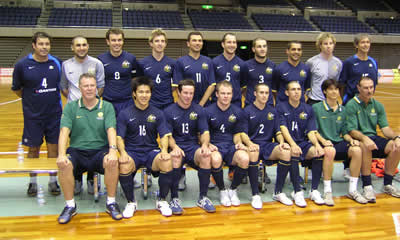
The ?Rise and Fall and Rise Again? tale of Futsal in Australia is perhaps just as riveting as the game itself.
It seems a lifetime ago that Australia was on top of the indoor football world as a top-10 nation playing a game started and dominated by Latin-American and European countries for three straight decades.
Australia hosted and finished sixth at the 1988 world championships (four years after forming a team) and even had its national league shown on free-to-air television in a million dollar deal with building products giant James Hardie.
It was an incredible position to be in considering the country?s obsession with rugby league, union, AFL and cricket? but the fast train of Futsal glory ran out of track in the early 1990s and the Australian game started a slow, slippery slide down its golden global hill.
Futsal has always enjoyed healthy participation ? it?s quick, inclusive, fun, entertaining, non-discriminative (physically and culturally), passionate, indoors, etc ? but a distinct lack of administrative structure and financial backing after its 1980s boom left Australia failing to stabilise its early successes, both on and off the court.
Just as Australia?s Futsal boat hung precariously over a flat-world?s edge, an individual and organisational commitment to right the rudder and forge a new course has provided the sport with much-needed revitalisation.
Over the past five years in particular, Futsal associations and clubs across Australia have implemented structures for technical, team and administrative development, and extended elite pathways to players, coaches and officials.
The NSW Premier League and Super League and Melbourne Futsal League are established top-level competitions, and the highly-competitive national Hummel F-League is halfway through its second season. There?s even talk of steering the F-League back onto TV screens.
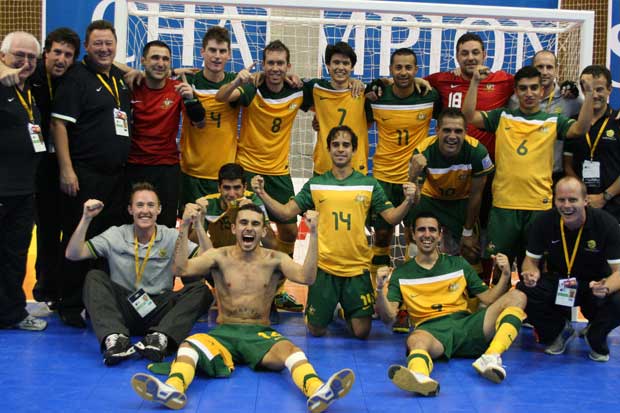
And look no further than the Futsalroos for a great gauge of Australia?s improvements after they finished fourth at the recent Asian championships to qualify for November?s World Cup carnival in Thailand.
——–
The story behind the pleasure and pain of Australian Futsal is outlined in this special three-part report by Dan de Nardi.
This feature looks at the game?s 1970s birth, ?80s rise, ?90s fall and new-millennium revival of Futsal in Australia.
The second part speaks with quadruple world cup veteran Erkin Osman (FIFA and FIFuSa) who played during Australia?s glory years in a televised national league and highly successful Indooroos side, and witnessed first-hand the sport?s spotlight triumph and tumble.
The third installment looks at the direction of Futsal, the development of an F-League, including insights from all eight 2012 Hummel F-League coaches and code administrators on the prospect of another televised national competition in the future.
Visit the F-League Facebook page (FNSWFLeague) and F-League competitions section for more details.
——–
From humble beginnings
Futsal is played by more than 12 million people (100,000+ in Australia), in more than 150 countries, on every continent.
Australia?s ranked a steady 31 in the world, fifth in Asia, and there are promising signs the Green & Gold could make a remarkable comeback to an international limelight it once dared share with Futsal royalty during a golden 1980s period.
But first a bit of background; Our good friends at Wikipedia tell us organised games started in Montevideo, Uruguay in 1930 when Juan Carlos Ceriani created a version of indoor football as a recreational activity for YMCAs. Over the next three years he developed and published rules, and even introduced a low-bounce ball designed specifically to help keep it in play longer.
The Brazilians, however, argue small-sided football games started on their beautiful beaches with a 1936 rule book published in a physical education magazine. (* Variations of indoor games have been recorded as far back as Canada in 1831)
Rules were modified in 1956 and in 1971 Brazil, Argentina, Uruguay, Paraguay, Peru, Bolivia and Portugal formed the Federaci?n Internacional de F?tbol de Sal?n (FIFuSa). Its inaugural president was Joao Havelange, who left to become head of FIFA from 1974-1998.
(* In 2002 FIFuSa changed its name to the Asociaci?n Mundial de Futsal (AMF) but many nations, including powerhouse Spain and the Netherlands, refuse to join due to the 58-member body?s inclusion of ?unrecognised? countries such as Kosovo and the Spanish regions of Catalonia, South Ossetia and Basque Country)
According to various reports, the first competitive indoor football game in Australia was played at the YMCA Sporting Complex in Epping, Sydney, in late 1970, introduced by new-immigrant Edwin ?Eddie? Palmer who had recently arrived from East Africa. Karl Plexis was centre administrator at the time.
It?s also reported that during a wet 1971 winter, when outdoor grounds were closed for many weeks, Dawn Gilligan, Jack Bowder and a few other parents of outdoor players helped co-ordinate an indoor match at Sydney?s Revesby YMCA, then managed by Joe Brent.
Gilligan and Brent wrote to England to obtain official rules and the game spread to other YMCAs. (* More on the game?s birth can be found in Gilligan?s submission, The Truth As I Know It)
In 1977 Brent became first president of the Australian Indoor Soccer Association, which affiliated with FIFuSa two years later playing under rules from one of the game?s original forms. The first national championships took place in Melbourne in 1980.
Conducted over 15-minute halves with no substitutes, players used arena walls to rebound the ball past opponents. The ball had to stay below head height and outdoor footballs were used before the introduction of a Nassau fluro green-felt ball that was easier to see against light-coloured gym walls. (* Line markings replaced walls as boundaries in the early 1980s following a notion that walls increased the risk of injury and rebounding rewarded errant play)
On the world map and TV
The sport blossomed brightly and FIFuSa held its first world tournament in Sao Paulo, Brazil in 1982, which the home nation won during a dominant 23-year unbeaten international run. (* One claim states Brazil went 920 indoor matches undefeated from 1957-1988 but reports show Paraguay beat Brazil in the 1965 South American final)
Australia entered and finished a credible eighth at the second world championships in Madrid, Spain in 1985, a 6-1 win over Canada splitting tough 12-0 and 3-0 losses to hosts Spain (in front of 21,000 people) and Uruguay. Brazil again won the final.
Down Under and a major cash injection from building product giants James Hardie helped sponsor the first National Indoor Soccer League (NISL) covering Australia?s eastern states and territory. (* Teams eventually included Sydney Tornadoes, Western Sydney Swans, Parramatta Spartans, Kellyville Commodores, Gridline Eagles, White Eagles, Lotto Allstars, Melbourne Buffalos, Melbourne Eliminators, Mackay Monarchs, Canberra Strikers, Canberra Rockets, Perth Cougars)
SBS picked up the broadcast rights, the Tornadoes won the first three seasons, and as viewers and participants increased, so did corporate interest. (* Johnny Warren wrote in the Sydney Morning Herald, December 20 1987, that James Hardie poured $1 million into the 1987 league)
(* Here?s footage of the 1989 NISL semi-final between White Eagles and Sydney Tornadoes hosted by Andy Paschalidis, and a 1987 Canberra Strikers vs Gridline Eagles game hosted by Johnny Warren)
The Futsal good times kept rolling as Australia hosted the 1987 Pacific Cup and knocked over Japan on its way to losing to favourites Mexico 3-1 in extra-time of a rousing final in Canberra.
Australia?s global showing helped it win hosting duties for the 1988 FIFuSa World Championships and games were held in Canberra, Wollongong, Melbourne, Geelong and even the rural Victorian township of Moe.
The tournament proved a great success for the host country and a national TV audience watched the ?Indooroos? finish group runners-up after they smashed Hungary 16-0 and Italy 12-0 (* See highlights here), only losing 6-1 to fancied Uruguay.
The second-round draw was horrendous. Australia did well to contain heavyweights Brazil in a 5-0 defeat and a second loss to eventual champions Paraguay 8-1 ended their run. The Aussies bowed out on a high note by conquering a strong Argentina side 7-3 in an electric contest in Geelong to place sixth overall. (* The outdoor Socceroos had beaten Argentina 4-1 earlier that year)
Paraguay went on to deliver Brazil its first international indoor football defeat in 23 years with an epic 2-1 final victory.
Australia would finally kiss a trophy when they beat Costa Rica 3-1 in the 1989 Pacific Cup final in Mexico and in another Johnny Warren Sydney Morning Herald article a James Hardie representative stated that indoor soccer was ?one of enormous spectator and participant growth and a sport of the future?.
It must have been a 20-year vision for as good as Australia seemed to be going, the game was unfortunately at its nationwide peak and, ironically, it was an international squabble that hastened its downhill slide.
A new direction? downhill
In 1989 FIFA (in dispute with FIFuSa over the name ?futbol?) agreed to combine all variations of small-sided football and integrated most countries playing the sport. This was done under the guidance of then president Joao Havelange and general secretary Sepp Blatter.
FIFA then split with FIFuSa, introduced a new set of rules ? foul limits, full-court access for all players, no offsides, no ball height restriction, squarer goals, smaller ball ? and baptised the sport we know today as Futsal (from the Spanish ?futbol sala? or Portugese ?futebol de salao?, which roughly means ?football in a large room?).
The Australian body followed suit and changed its name to Australian Futsal Association (AFA) in 1989.
The inaugural FIFA Futsal World Cup was held later that year in the Netherlands, where a brave Australia (the team made up of NSL and Socceroos players) failed to make it out of a tough group despite holding eventual semi-finalists USA to a 1-1 draw and beating unfancied Zimbabwe 4-1. Unfortunately, a 6-1 loss to Italy forced their early exit. Brazil beat their Dutch hosts 2-1 in a tense final.
The good-time lustre was clearly fading. The sport worldwide had become more professional and Australia?s development stagnated from massive underfunding.
Some reports suggest a tug-of-war between Sydney Tornadoes owner Mike Wrublewski and AFA chief Joe Brent also rocked the Aussie Futsal boat, Wrublewski withdrawing his financial support and other club chiefs following him out the door.
Whatever the contributing factors, the effect was devastating.
The NISL was pulled off air after James Hardie pulled its sponsorship; it eventually faded (a Steve Knight led Kellyville Commodores winning the 1991 title before it completely dropped off the radar), and feats such as quadruple world cup veteran Erkin Osman (his 15 world cup matches in Australian colours unlikely to be surpassed anytime soon), twinkle-toed Radovan ?Shishka? Filipovic, goalkeeping hero Bruce Thurlow and Glenn ?Java? Jeffery went terribly understated by an uninterested media.
The indoor scene itself was divided with supporters of FIFA and FIFuSa splitting allegiances, resources and exposure, and disunity at an international and national level proved the catalyst for Australia?s dismal efforts at a farcical fourth FIFuSa world championships won by Portugal in Milan, Italy in 1991.
Despite ongoing disruptions Australia did well at the 1992 FIFA Futsal World Cup in Hong Kong, outstanding in a tight 3-0 loss to defending champions Brazil and they led Belgium 1-0 before losing 2-1 in a result that dashed their progression hopes. The Indooroos ended the tournament with a highly entertaining 8-6 win over Costa Rica to again finish third in their group, and Brazil would win the final.
The Costa Rica victory was the last world cup win by any Australian indoor side.
What followed was a painful Aussie micro-sleep (from 1993 to 2007) that resulted in a dreadful global record (excluding 21 unbeaten Oceania games) of just five wins, five draws and 30 losses from 40 internationals (Ed: From a recorded 15 FIFA & FIFuSa/AMF world cup matches plus 25 ?friendlies?).
The lean years
Australia?s global reputation tumbled on the back of several heavy world cup defeats, mainly due to low exposure to quality opposition and apparent disharmony at an administrative, coaching and playing level.
The Aussies had seemingly become complacent on Oceania receiving a full qualification place (scoring 158 goals and conceding 18 in 21 easy wins over four successful campaigns from 1992 to 2004), but a distinct lack of credible and organised competition would then show them up on the world stage.
Australia hasn?t won a world cup game since they joined Oceania in the early 1990s.
The Aussies won four of nine FIFuSa world title games in 1985 and 1988. Since then Australia?s claimed two wins and a draw from their 15 FIFA world cup matches (1989-2004), and just a 3-3 draw with Mexico to show from their last 15 FIFA (1996, 2000, 2004) and FIFuSa (2000, 2003) appearances combined.
On the FIFuSa side, Australia missed Argentina 1994 and Mexico 1997, were gallant in their Bolivia 2000 return (beaten by Uruguay 6-1 and Belarus 6-4, drawing 3-3 with Mexico), but bombed badly at Paraguay 2003 (pinged by the hosts 5-0, Peru 7-zip and Belgium 7-5) to finish second last? and they haven?t been back since, losing out to New Zealand in a penalty shootout (Australia led 3-1 with three minutes to play) for a place at the 2011 edition won by hosts Colombia.
The Aussies did little better with FIFA, scoring four goals and conceding 26 in a three-game whitewash at Spain 1996 (although they did face two eventual semi-finalists in their group, the hosts and Ukraine, 7-0 and 11-2 losses, separated by a 7-2 loss to African champions Egypt).
They were as equally outclassed at Guatemala 2000, losing to rivals Costa Rica 6-2, Croatia 6-love and eventual semi-finalist Russia 10-1, and fared worse at Chinese Taipei 2004, suffering their biggest world cup defeat in a 10-0 capitulation to Brazil, losing 5-zip to the Czech Republic, and only finding the back of the net in a 2-3 loss to Thailand in their final group game.
Australia didn?t make 2008 Brazil, their qualification path made more challenging by a switch to the Asian confederation in 2006.
Despite unflattering results, national Futsal coaches have traditionally held their posts for lengthy periods. After Australia?s initial success under Nick Nicolapoulos from 1984-1988, winning four of nine FIFuSa world title games, the Indooroos/Futsalroos have only had three coaches since Tim White led a predominantly outdoor side to the Netherlands in 1989 for one FIFA world cup win and two losses.
Jimmy Roberts coached Australia in a turbulent reign from 1990-2000 (one win, eight losses), Scott Gilligan took over when the Futsalroos crossed from Oceania into Asia during a tough 2001-09 rebuild (three losses), while Steve Knight took the baton in 2010 and has guided the Aussies back to the Futsal World Cup in Thailand this November.
The Orient express
Fortunately fires burn boldly in the Australian Futsal forest and passionate supporters, players and administrators fanned the fading flames until a recent resurgence helped stabilise the sport and offer renewed hope for the future.
Futsal administration is markedly more consolidated and connected, competitions structured, elite pathways implemented and players, coaches and officials better trained and developed.
Representative opportunities have particularly improved and perhaps nowhere more evident than Australia?s triumphant return to the world stage at Thailand 2012. (* Australia joins Brazil, Argentina, Spain, Italy and Iran as the only countries to qualify for at least six of the seven World Cups)
Certainly, the decision to pitch Australia into the Asian confederation was a masterstroke of genius.
With the ease and complacency of qualifying through Oceania an obvious barrier to international success (1-0 defeats of Vanuatu and Fiji in 2004 the closest of 21 contests), Australia joined Asia in 2006 with dramatic and immediate effect.
Though they narrowly failed to make the 2008 Futsal World Cup in Brazil, hard-fought results over a grueling six-year Asian campaign has only battle-hardened the Aussie resolve.
On the road to Uzbekistan 2006, Australia topped its qualifying group with tight 3-2 and 5-4 wins over Hong Kong and South Korea followed by a 16-2 romp of Macao, but a 4-7 loss to Kyrgyzstan at their first-ever Asian finals nullified strong 7-4 and 6-4 wins over Kuwait and Lebanon with the competition headed straight to a semi-final stage, the ?Futsalroos? finishing a solid equal-fifth.
At Japan 2007, an opening 0-1 loss to Turkmenistan and 3-1 defeat of South Korea meant Australia would top the group if they beat rivals Kyrgyzstan and miss out altogether if they lost. The Aussies bolted to a three-goal lead and held on for a nervous 3-3 draw, and with South Korea beating Turkmenistan the Futsalroos were through to the quarter-finals. Unfortunately they were matched with 10-times Asian champions Iran and soundly beaten 8-0.
Australia also performed admirably at the world cup qualifying event in Thailand 2008 (the top-four finishers guaranteed a place at the Brazil finals later that year). They beat Turkmenistan 3-1 and Taiwan 6-0 before a tough 2-4 loss to Japan saw them progress as group runners-up. The Futsalroos lost a close quarter-final against hosts and eventual finalists Thailand 5-2 to just miss out on a world cup spot.
More teams entered the 2010 fray and Australia was thrust into ASEAN (south-east Asia) qualification where they steamrolled Myanmar 6-1 and Indonesia 4-1, beat Vietnam 4-1 (to qualify for the Asian finals), and toppled Indonesia 3-0 in the final.
At Uzbekistan 2010, Australia downed Kuwait 4-2 and held Asian heavyweights Iran 3-3 at halftime before surrendering 9-3, which meant they needed to beat Tajikistan to make the knockout. The sides went goal for goal until Futsalroos (and Mariners A-League player) Tom Rogic scored a late 5-4 winner.
The Aussies went down fighting in a 5-3 quarter-final loss to hosts and eventual finalists Uzbekistan. (* Watch all Futsalroos goals here)
Back on the world stage
The 2012 world cup qualifying campaign started with Australia running an ASEAN qualifier gauntlet, a comprehensive 15-0 win over Cambodia tempered by a 4-4 draw with Malaysia (the Aussies led 4-2 with two minutes to go) and 2-2 draw with group winners Vietnam (again giving up a late lead).
Australia were thrashed 7-blot by hosts Thailand in the semi-final and needed to beat Vietnam in the third-place playoff to claim the final qualifying spot. It all looked good at 4-0 up until Vietnam scored three goals in two minutes to set up a tense final two minutes of play, the Futsalroos hanging on for an edgy 4-3 victory and earn their ticket to the United Arabs Emirate.
The four semi-finalists at the UAE finals would qualify for the 2012 Futsal World Cup in Thailand and Australia certainly hit the ground running, solid 3-1 and 6-0 wins over Qatar and South Korea countered a 9-0 loss to Iran to help the Aussies finish group runners-up.
In a nail-biting quarter-final match-up against Kuwait, an extra-time Daniel Fogarty goal lifted Australia to a 3-2 victory and automatic world cup berth (* Watch the thrilling highlights here).
The Futsalroos did well in the semi-final, holding eventual winners Japan to 0-0 for half-an-hour before succumbing 3-0, and they were also 0-0 with four minutes to go in the bronze-medal playoff against Iran until four straight goals decided the podium contest.
It didn?t matter ? the Aussies were back on the world stage. Bring on Thailand!
* In the second installment of Futsal in Australia, indoor icon Erkin Osman gives his first-hand account of a televised national indoor soccer league, world cup heroics that included a hat-trick against Argentina and winning a Pacific Cup on Latin American turf, and speaks openly about his belief the sport can return to its glory days again.
Visit the F-League Facebook page (FNSWFLeague) and F-League competitions section for more details.
By: Dan de Nardi