Football NSW responds on rubber infill safety
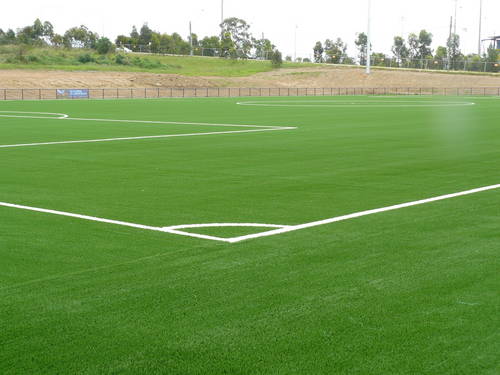
A perception is created that the rubber granules used in the construction of synthetic turf fields may put the health of individual participants at risk.
Football NSW as the peak governing body for football in New South Wales, considers the safety of all members of the football community is paramount. In undertaking its own enquiries Football NSW has been informed by a number of leading experts and manufacturers that the rubber granules used in synthetic turf fields pose no health threat to participants.
Professional synthetic turf expert Martin Sheppard, Managing Director of Smart Connection Company, has over 20 years? experience on the use of synthetic turfs in Australia and Europe, considers that local communities, football clubs and associations should have confidence in the fields that they and their children are playing on.
?The recent press coverage regarding the possibility of leaching of chemicals or possible infection from the recycled tyres used as infill in the football fields, may have generated mistrust and confusion in the community. There has been considerable independent research conducted as well as the exacting standards established with the world governing body FIFA.?
Mr Sheppard also referred to research conducted by The New York State Department of Health (2009), California Environmental Protection Agency, The Swiss Ministry of Environment, Traffic, Energy and Communications (2005 -2007), The Norwegian Institute of Public Health (2009), The French National Institute of Industrial Environment and Risk (2008). All the reports concluded that there is significant evidence that there is limited impact on the health of the participants from the infill when used within the acceptable limits. These limits are endorsed by FIFA as a standard for playing surfaces
In Football NSW CEO Eddie Moore echoed the significance of safety and the requirements for artificial surfaces within FIFA standards.
?As the governing body we will continue to work with manufacturers, councils, state and federal bodies and FIFA to ensure the game of football is played in a safe environment.
?A number of our synthetic turf surfaces have met and exceeded FIFA?s most stringent testing standards.
?These standards are not only established to ensure the game can be transitioned onto alternative playing surfaces but also warrants player safety which is by far the most important concern.?
FIFA has issued quality standards for synthetic football pitches since 2003 through its Quality Concept for (synthetic) Football Turf.
Moreover FIFA states in its Laws of the Game that where synthetic surfaces are used it must meet the requirements of its Quality Concept for Football Turf or the International Synthetic Turf Standard.
Every turf product used at football grounds for football competitions must first pass FIFA laboratory tests to determine its composition and must then be tested for durability, joint strength, climatic resistance, player-to-surface inter?action and ball-to-surface interaction. In addition, the reaction of the turf to the skin of the players, when sliding on the surface, will be measured in form of skin abrasion and friction for the higher of the two FIFA recommended levels. If it passes all these tests, the first stage of the process towards the award of the recommended marks is completed.
In the second stage, every installed pitch must be tested on site. Firstly, specialised field-testing equipment measures how the ball reacts on the surface in terms of roll, vertical rebound and how the ball behaves when it strikes the surface at an angle. Then it must similarly be tested to see how it reacts to the actions of players ? including shock absorbency, surface deformation, slip resistance and traction.
If the football turf pitch passes all the laboratory and field tests, it will qualify for one of the two FIFA recommended marks. The marks will only be given to an installed pitch and not simply to the turf carpet. This is because the underlying base surface is just as important to the playability of the pitch as the turf itself.
The FIFA certification and licensing programme, which was launched in February 2001, means that purchasers of football turf (including councils) can rely on the FIFA recommended endorsement when making their decisions. This endorsement is a mark of outstanding quality, optimum playing comfort and regular checks by FIFA.
Further comments from various industry artificial turf experts can be viewed here:
FieldTurf responds on rubber infill safety
Artificial turf beat up fails to highlight alternatives
Media ‘beat up’ artificial turf: synthetic grass
-Football NSW Release