APIA Leichhardt Tigers? tour diary of the Viareggio Tournament
Day 1 – Saturday 28th January 2012
The day has arrived when the touring party from Sydney gathered at Sydney?s Kingsford Smith Airport at 1.00pm ready to depart at 4.15pm on Singapore Airline flight SQ226 bound for Italy via Singapore. On arrival at Singapore?s Changi airport the Sydney contingent of the touring party met with their interstate team members which all came from Victoria. They are, Matthew Napoli, Frank Proietto, Patrick Barba, Christopher Shaw, Tuo ? Yeng Yang and Brandon Kuzamonvski.
Also upon landing at Singapore?s Changi Airport the group was stunned at the magnitude of the vast size of this mega international airport.
It is the world?s most awarded airport, and the seventh busiest international airport. What?s even more astonishing, Changi Airport handled more than 46.5 million passenger movements last year.
This amazing airport serves some 100 airlines flying to over 210 cities in about 60 countries and territories worldwide.
A final amazing statistic ? a flight takes off or lands at Changi Airport roughly once every 100 seconds.
Day 2 – Sunday 29th January 2012
The Apia Leichhardt Tigers Touring Squad arrived at 7am at Rome?s Fumicino Airport with a tournament playing squad of 17 players and 7 ?apprentices?.
The playing squad was accompanied by coaching, administrative, physio and a media contingent of 8. After arriving at Rome?s Fumicino Airport at 7am and by 8am the touring party had already settled into the tour coach for quick departure towards Rome?s historic CBD, in a day with a temperature of 7 degrees, but brilliant sunshine.
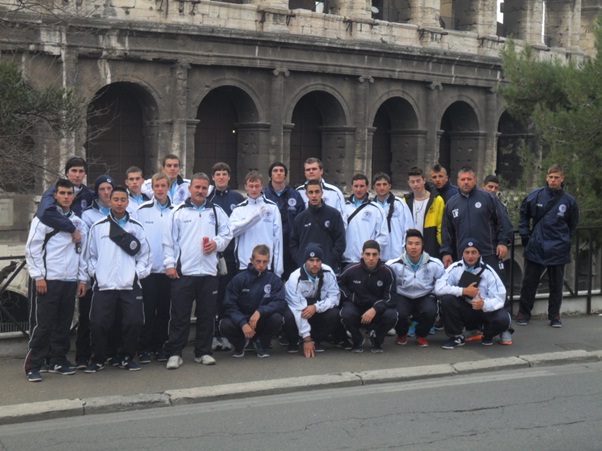
First stop was made at a local food caf?/restaurant service station for a light breakfast and coffee break. Then the team headed for the Colosseum, in the city centre of Rome.
The Colosseum is the largest ever built in the Roman Empire. It is also one of the greatest works of Roman architecture and Roman engineering.
Occupying a site just east of the Roman empire, its construction started between 70 and 72 AD. Capable of seating 50,000 spectators, the Colosseum was used for gladiatorial contests and public spectacles.
It has been estimated that about 500,000 people and over a million wild animals died in the Colosseum.
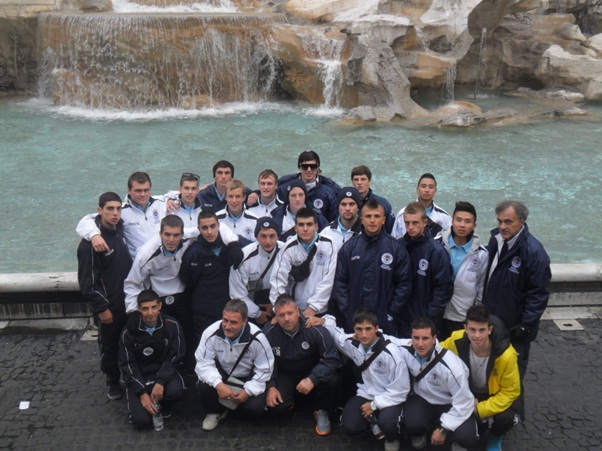
After a brief 20 minute visit the touring squad headed towards one of the world?s most famous tourist spots ? the Trevi Fountain.
It would be the last time that the group would have access to the club?s tour bus, due to the fact that tour coaches are not permitted within the main heart of Rome?s central business district.
It was all now by foot for the next 3 hours and 48 hours since the touring party had slept in a proper bed.
Now back to the Trevi Fountain, which is the largest fountain in Rome. The Trevi Fountain is at the junction of three roads and was one of the ancient aqueducts that supplied water to ancient Rome in 19 BC.
It was a source of pure water, some 13km from the city. The fountain was refurbished in 1998. A traditional legend holds that if visitors throw a coin into the fountain, they are ensured a return to Rome.
Approximately 3,000 euros are thrown into the fountain each day. The money is used to subsidise a supermarket for Rome?s needy. From there the group headed towards the Spanish Steps. These steps are the longest and the widest staircase in Europe.
This monumental stairway of 138 steps faces directly across Rome?s most famous and one of Europe?s most expensive streets ? Via Condotti. The Via Condotti is home to most of Italy?s and the world?s magnificent fashion houses and retail brands. They include Gucci, BVGARI, Prada, Johnny Choo, Versace, Max and Co, Salvatore Ferrogamo, Luis Vitton, Fendi and the Ferrari shop. Even at this very early hour in the morning there was thousands upon thousands of tourists, with a sprinkling of superbly and immaculately dressed local?s.
There is no doubt in the world that the Italian dress and fashion sense, even just merely going to church, work, the local supermarket or for a simple stroll, is unparalleled anywhere in the world.
Back to the Spanish steps, they are not a place for eating lunch. Eating food, sitting on these steps is strictly forbidden by Roman urban regulations, but they are always crowded with hundreds of people at all hours, at all times and during any weather conditions.
After another brief visit, we headed along the Via Condotti towards the Vatican City. But not before a quick entry into the no 1 Ferrari retail outlet in the world.
It was a case of only looking, admiring and definitely not even the slightest hint of buying anything. The prices for all the products in this store are ludicrous and only fools would contemplate making a purchase. Thankfully there was not a solitary fool within the Apia party.
The hype surrounding the store is pitiful, with the retail staff insisting no photos were permitted to be taken. For God?s sake all the Ferrari products are clearly visible on any internet site referring to Ferrari. It would be a wise move for the club to eliminate any future visits to this insignificant retail outlet.
The group then proceeded forward along this magnificent street, with starting prices for two bedroom apartments hovering around the 4 million euro mark.
We continued our 40 minute walk towards St Peters Square, after having walked the entire Via Condotti and then veered and meandered our way along the banks of the Tiber River. This massive river cuts through the entire mega metropolis of Rome which is undoubtedly, within the top three cities in the world.
As we continued our trek along the Tiber river, we witnessed at least a couple of hundred legal and illegal immigrants attempting to earn a living by attempting to entice the 50,000 or so tourist?s heading towards the Vatican City, by purchasing toys, umbrella?s and imitation brand watches.
It appeared that sales were very slow, not to mention the difficulties encountered by at least 20 to 30 elderly beggars pleading with the tourists to give them a small donation. We had no idea whether these beggars truly had limited financial resources, or no income at all, and due to their age, absolute no prospect for job opportunities.
But it was disappointing to witness so many beggars in such a major city, with obvious financial strength ? not supporting in some financial capacity, housing, food or otherwise, what on face value appeared to be genuine people, for one reason or another, down on their luck.
Finally the vast St Peter?s Square and the mind boggling Vatican Cathedral came into our view. We walked along towards the square with tens of thousands of chanting and singing tourists and pilgrims, who were walking briskly to arrive by 12 noon within St Peters Square.
When the leader of the Catholic church is in residence, at exactly 12 noon, the Pope gives his blessing to the vast crowd well in excess of 50,000, in no less than 12 languages. A large number of the group lined up to enter the world?s largest church/cathedral, whilst others browsed within the many souvenir and gift shops in close proximity to St Peters Square.
The Vatican City is a landlocked sovereign city-state whose territory consists of a walled enclave, within the city of Rome.
At approximately 110 acres and with barely a population of 800, it is the smallest country in the world, by both population and area.
The Vatican City is a city-state that came into existence in 1929. The Pope is the head of state and the head of government of the Vatican City.
Finally we met up with our bus driver Salvatore, who has been the club?s tour coach driver for 9 out of the 10 years, the club has participated in the Viareggio tournament.
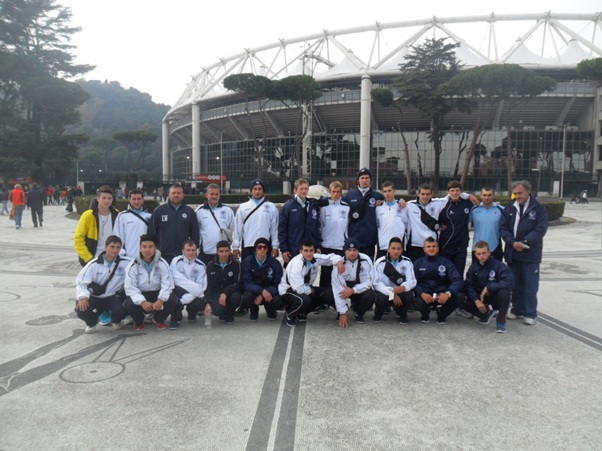
It was 2pm and he arrived on schedule, which is a rarity for Salvatore, to ensure our journey to Rome?s Olympic Stadium, for the Rome vs Bologna Serie A clash, which finished in a 1 all draw.
We quickly disembarked on arrival at this magnificent sporting complex, but before entering the stadium the entire tour party were keen to purchase porchetta (pig) toasted paninos and pizzas, from the various food outlets outside the stadium.
It was approximately 2.20pm, with a 3pm kick off, and it was obvious that Roma?s vast army of supporters were turning up in large numbers, due to the fact Roma hadn?t lost in the past 6 weeks, and were slowly heading up the League ladder.
Once inside the Olympic stadium, we were stunned with the mass sea of scarves and flags, that virtually every supporter, was proud to wear, and show their colours.
The match unfortunately was average, but the atmosphere and passion of the fans was electrifying. Our group left 15 minutes before the end of the game to avoid the massive congestion and traffic, that would prevail with over 48,000 spectators scrambling to their thousands of scooters, bicycles, motor bikes and cars, to get home in a city typical of most Italian cities ? utter bedlam, chaos and loud constant noise, that is the beauty of Italy ? its people, are always full of life and live for the day.
Tomorrow can take care of itself, when it comes around. As the group headed towards the Hotel Losanna in Viareggio, approximately a 5 hour trip, they would have been reflecting, on having spent a magnificent day, in what is without doubt the most beautiful ancient city in the world.
Modern Rome is a bustling cosmopolitan metropolis, and is Italy?s capital of politics, economy and media. It is a city rich in history, art and culture and its priceless monuments and treasures have led Rome, to attain an extraordinary Unesco World Heritage listing on many of these sites .
Its modern and ancient global influence in politics, literature, culture, music, religion, education, fashion, cinema and cuisine surely would entitle Rome as possibly the most magnificent city in the world.
Upon arrival at the hotel, the group was again warmly welcomed by the hotel?s owners ? the Smurro family. After a hour or so settling in period, in their rooms, the players and tour administration, quickly fell asleep.
Day 3 – 30th January 2012
Coaching staff Rod Williams and Lince Romeo, keen for the playing group to attempt to clear jet lag and have the players quickly acclimatised to the local conditions. As such after a tiring 48 hours travelling and the gruelling day tour of Rome ? the team departed at 9.15am, for a stretch, warm up and training match at a local park ten minutes from the team hotel.
After a sharp, quick tempo training match, of 30 minutes each half, the team quickly moved on to the local heated swimming pool, which is adjacent to the park, for a well deserved recovery session.
The recovery session was professionally supervised and organised by the club?s physiotherapist, David Floro. From there, the playing group, returned to the hotel for lunch and well deserved downtime, and much needed rest.
At about 4 pm, the group left their headquarters (which is more like a comfortable three storey family home than a hotel) for a 1 ? hour walk along the water front, also in around Viareggio?s CBD area, to familiarise themselves with their home base for the next 15 days.
Viareggio is a city and commune located in the northern Tuscany region of Italy, on the coast of The Tyrrhenian Sea, with a population of 64,000. It is the main centre of the Northern Tuscan Riviera ? known as Versilia ? and the second largest city, within the spectacular wall enclaved province of Lucca.
Known as a seaside resort, as well as being the home of the famous carnival of Viareggio, dating back to 1873, and its floats, which since 1925 parade along the promenade known as ? Passegiatta Al Mare?, in the weeks preceding Easter.
The Viareggio carnival, is the second biggest in the world, after Rio De Janiero. Viareggio is also an active industrial and manufacturing centre.
It?s shipbuilding industry, has long been renowned around the world, and it?s fishing and floricultural industries are still fundamental sectors to the cities economy.
-By Tony Raciti and Mannie Ziino